Exams
Using practice exams the right way.
A practice exam shows you what you really know, and that's exactly why you learn more from it than from any amount of rereading.
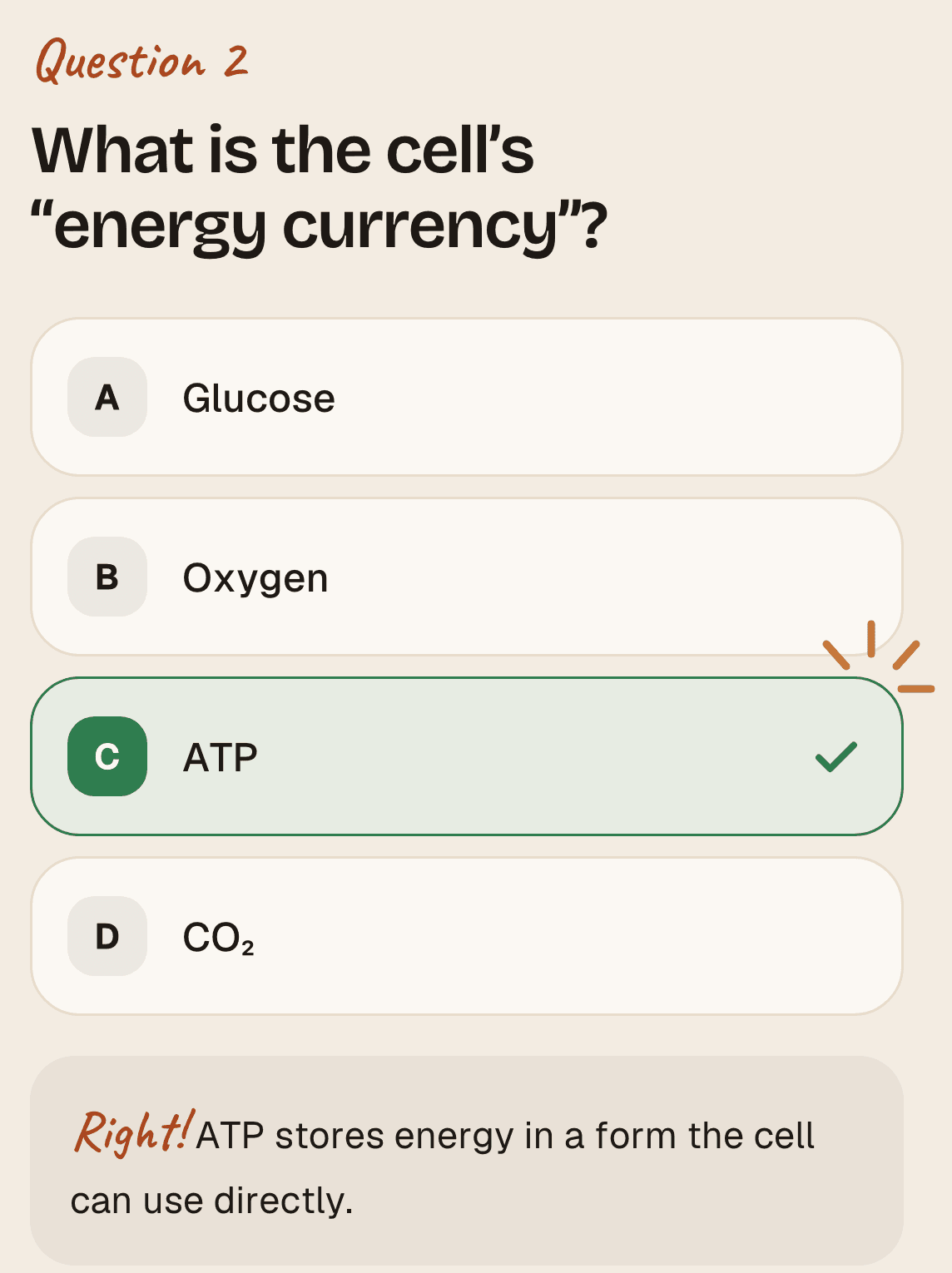
- Testing yourself helps you remember more than rereading, one of the best-supported findings in learning research.
- Take your first practice exam early enough and under real conditions, so there's time left to fix your gaps.
- The most important part comes afterward: review your mistakes and go back over exactly those topics.
Many students save the practice exam for the night before, as a final check that everything sticks. But it's much more than a check. Here's why practice exams work so well and how to get the most out of them.
Why practice exams work so well
In 2006, Henry Roediger and Jeffrey Karpicke had students study short prose passages. Some read the passage again, others wrote down everything they remembered. A week later, the students who had been tested remembered more, even though they had read the text fewer times.
Just as interesting is how confident each group felt. The students who had only reread rated their own knowledge higher. Rereading feels safe because the text seems familiar. A test, on the other hand, shows what you can actually recall.
Rereading feels like knowing. A practice exam shows whether it is.
When to take one
Don't take your first practice exam the night before. Take it once you've worked through the material and still have days left to fix things. About a week before the exam is often a good time. A second one shortly before the end shows whether the gaps are closed.
Until then, small quizzes after each chapter are enough, for example with flashcards. A full practice exam trains something else: recalling all of the material in one sitting and under time pressure, just like the real exam asks you to.
Recreate real exam conditions
A practice exam helps most when it feels like the real one. That way you practice not only the material, but also your sense of timing and writing under pressure.
- The same time limit as the real exam, with a clock in view
- No notes, no looking things up, phone out of reach
- Write by hand if the real exam is on paper
- Do it all in one sitting, without checking anything in between
Review: the most important part
Once you hand it in, the real learning starts. Go through every question where you lost points and ask yourself why. Different causes need different fixes.
| Mistake | How you spot it | What helps |
|---|---|---|
| Knowledge gap | You just didn't know it | Relearn the topic, then quiz yourself |
| Understanding | You knew the terms, not how they connect | Explain it in your own words |
| Time | You didn't finish | Practice questions with a timer |
| Careless error | You knew it but misread the question | Read questions slowly |
A good test of yourself: before you start, guess what percentage you'll get, then compare it with your result. If you guessed much higher, you know your confidence and your knowledge don't match yet.
Where to find exam questions
Old exams from your course are best, because they show the format and the level. Ask your professor or TA, or check whether your department or a student group keeps past exams. If there aren't any, use problems from the textbook or write your own questions for each chapter.
Before you start writing, Hazelnote asks what score you expect and compares it with your result after grading. Then you see your points, your grade and, for every question, what was still missing.
Your checklist for the next exam
- Set a date for your first practice exam
- Get hold of old exams or practice questions
- Time yourself and write without notes
- Guess your score before, compare it after
- Go back over your three weakest topics
Common questions
The bottom line
A practice exam isn't a test for the night before, it's one of the best ways to study there is. Take it early enough and under real conditions, and give the review as much time as the exam itself.